
It takes one to know one. Here’s a day in the life of a radiologist, illustrated.
Courtesy: http://adf.ly/1NBMac
It takes one to know one. Here’s a day in the life of a radiologist, illustrated.
Courtesy: http://adf.ly/1NBMac
To top it all off, med students are burdened with volatile subjects like Biochemistry and pharmacology. Doing biochemical tests on urine samples is disgusting as it is, but what really puts the drain on the mental faculty are all those biological cycles of all the metabolic fates of carbohydrates, proteins and fats in the human body. Its one helluva job memorizing them and another recalling them in the examination hall. Besides you forget them all after the Professional examinations.

Courtesy: chemistry.tutorvista.com/biochemistry/metabolism
The hardest part of this saga are indeed the professional exams, which hang like a sword over the heads of students all through there student life. The whole administration seems out to get you. You have to be mentally tough to take the pressure of it all. But once you are through, you feel you can take on anything in life.
Somehow the years roll over. While first and second year seem to take ages and the end never seems in sight ( o why have I landed myself in this mess?) , third and fourth years seem like a whirl wind (which is so ironic because you really start getting the hang of things). Either the studies get easier or you have grown immune to the stresses and strains by now, but somehow life becomes more tolerable. And after two years of beating about the bush and studying what they call the ‘normal’ we come face to face with the diseases themselves- the ‘pathology’, our real enemies. This is the domain all doctors strive to conquer- the real basis of medicine. The medical student uses the eyepiece of the microscope to stalk down this enemy.
Courtesy:/dehradunlive.in/search/wp-content/uploads/2013/07/Goyal-Pathology-Lab-Dehradun
But this is no combat situation. We just view these dead, diseased tissues which have been stained with Haematoxylin and Eosin- the ‘pink’ and ‘blue’ one sees under the microscope, that adds color to these dead and dull-looking tissues and makes slide viewing a tolerable experience.

Courtesy: http://amida13.isi.uu.nl/
The real battle is fought in the wards. So clinical rotations are an important part of this training programme.
Although there is nothing really glamorous about going around hospital wards taking case histories and doing ‘general physical examinations’ (GPE), but moving around with seniors on ward rounds is exciting. You get your share of flattering remarks and disapproving looks from Professors and patients alike.But amongst the many faces of life in a hospital a familiar one is the face of helplessness. It screams at you as you go past the waiting area, or go down those dimly lit corridors. Rows and rows of patients, grieving , in pain, helpless- and in contrast to all those dead bodies in the dissection hall-alive.
And it seems almost as if someone has strapped a heavy load onto one’s shoulders. The sense of responsibility weighs one down. By becoming part of a few moments in the lives of these patients, doctor and patient are bound in a sacred trust that transcends all barriers of cast, creed and social status and one becomes accoutable to one’s own conscience.
Regardless of all the degrees, medals and years of experience, a new patient is always a new challenge to a doctor. All tall claims finally boil down to the basic relationship that a doctor has with his patient. an impression left by any doctor in the mind of his patient reflects upon the whole profession. Once let down, he will never trust his life with any doctor. The jinx of the doctor being a ‘Messiah’ shall be broken forever. Because there is no room for errors in the medical profession, and to the common man ‘people in white coats’ are all the same.
View full article published in healthmad.
Visit :

http://healthmad.com/medicine/in-white-coats-2/
Please don't forget to like, share and comment on the website too.
Getting admission into a medical school can prove to be a great launching pad but only if you take full advantage of it. Whether you were a straight-A’s student or someone who slid through High School with minimal effort (and marginal results), medical school is a new platform to start from- a new opportunity to show you’ve got what it takes to be successful.
But nothing in the world can prepare you for that dreaded encounter with the Dissection hall. It’s here, in the dimly lit hall, which reeks with the pungent smell of formalin that the dry, boring facts of Anatomy come to life. A few weeks in the Dissection Hall and you become emotionally immune to the dreary surrounding. Among rows of dead bodies draped in cotton swabs drenched in formalin, students watch as the mysteries of the whole miracle of creation unfold under their scalpels and forceps.Surgeons are said to be born here.
.
courtesy: http://www.aimst.edu.my/faculties/medicine/images/anatomy.jpg
What medical students owe to dissection halls for the study of Anatomy, they owe it to frogs and rabbits for the study of Physiology. ‘Stunning’ and ‘Pithing’ are just technical names for knocking them unconscious and bashing out their brains. Lying in glass troughs with their chests opened up and their hearts suspended in mid-air, they present a pitiable sight. A lever assembly converts the feeble contractions of their hearts into oscillations of the pen, which transfers them onto graph papers so that medical students can use these cardiogram recordings to study the functioning of the heart and the minute details of heart blocks.
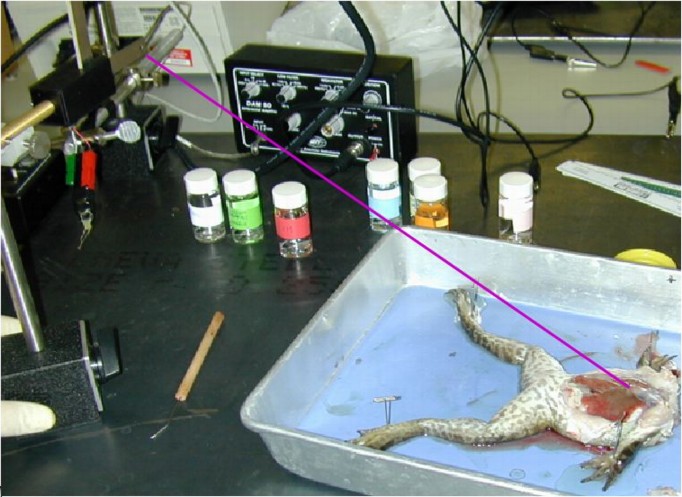
Coutesy: http://www.sci.utah.edu/~macleod/bioen/be3202/labnotes/l1-frog/descrip.html
To top it all off, med students are burdened with volatile subjects like Biochemistry and pharmacology. Doing biochemical tests on urine samples is disgusting as it is, but what really puts the drain on the mental faculty are all those biological cycles of all the metabolic fates of carbohydrates, proteins and fats in the human body. Its one helluva job memorizing them and another recalling them in the examination hall. Besides you forget them all after the Professional examinations.
Courtesy: chemistry.tutorvista.com/biochemistry/metabolism
The hardest part of this saga are indeed the professional exams, which hang like a sword over the heads of students all through there student life. The whole administration seems out to get you. You have to be mentally tough to take the pressure of it all. But once you are through, you feel you can take on anything in life.
View full article published in healthmad.
Visit :
http://healthmad.com/medicine/in-white-coats-2/
Please don't forget to like, share and comment on the website too.
Some believe that you become a doctor only after you have got an MBBS degree. In reality, from the time you are admitted into a medical school you become a part of the doctor’s community… the people in white coats!
’I solemnly pledge myself to consecrate my life to the service of humanity.
I will use my best judgement to help the sick and do no harm.
I will not give fatal drugs to anyone, even if asked, nor will I suggest any such thing.
I will not divulge the secrets of my patients regarding them as holy……’
There is something very hypocritical about this Hippocratic oath. Hippocrates, the famous Greek physician, must have formulated the oath for his disciples in the field of Medicine in the true interest of humanity and to uphold the sanctity of this noble profession. But now this oath-taking ceremony has been glamorized to befit white coat ceremonies to appease nostalgic minds, or worse still to harass doctors in court.
But then nostalgia and harassment run high in any Medical school. The Professors love to recall the days when they, as medical students, had studied till late in the night and spent the better part of this glorious period of one’s life in the dissection halls, the hospital wards, operation theatres or the library. Having been through this gruesome phase, some of them are sympathetic to the plight of medical students. But then there are some who take it out on this fast emerging strain of stress-resistant medical students who believe they can bunk classes, download video lectures and amazing new mobile apps about the Anatomy of the human body, attend concerts, have a nice time at McDonald’s and study Pharmacology with music in the background.
View full article published in healthmad.
Visit :
http://healthmad.com/medicine/in-white-coats-2/
Please don't forget to like, share and comment on the website too :
When a young lad marches into the world with all his degrees in a neat little file, all he asks for is a springboard from which to start.

Courtesy: http://www.mypersonalimprovement.com
While sailing along magnificently through the most productive years of his life, academically speaking of course, the guy who had broken last year’s college record of the greatest number of wickets in a cricket match, broke down. His father retired from government service and declared his financial assets before the boy. The family fortune was barely enough to see him through college. He was the eldest son and that in itself was self-explanatory of what was expected of him. He locked up his bat and ball and bade his cricketing pals goodbye. He looked a dilapidated man as he walked off the cricket ground, his dreams of stardom shattered, his studies all in a mess.
Out in the world, it was a different ball game altogether. There was no family enterprise to take over except a garment shop, which did not seem very enterprising to him. He started hunting for jobs. But here, he had few qualifications to prove his worth, and where he was academically adequately qualified he lacked experience. At last he found himself standing outside the Army recruitment centre staring at the sign-”The Army needs you”- They did.
It was a decent way of running away from home and responsibilities, or so he thought. But the rigorous military training soon drove the thought right out of his mind and he returned- a shaken man whose confidence in himself had been shattered. Sitting alongside his father at the shop, he wondered where things had gone wrong.
That’s the question most of us end up asking ourselves when we end up in the no-man’s land. The guy had been thrust into the world to make a niche for himself, but he needed some kind of footage- a springboard from which to start. For most people its the family business that cushions them when they start out to face the world. They are able to manage with what little talent they have. The graduate student who has his degrees to boast about may soon find that good grades may open for him the doors to top universities, but they cannot guarantee him a bright future. While the son of a business entrepreneur may go abroad to enhance his profile, the son of a grade 16 government servant may well just rust away.
Round about 22, when most of us jump off the diving board and plunge into the professional world, we are bursting with ideas, more adventurous than our predecessors and waiting to try out life’s uniforms. We have our competence to prove to the world, but we are also aware that we are on trial. This is the big moment we have been waiting for all along, and we want to strike it big. But if we rush head along into the professional world we are bound to be hit by a whirlwind. The susceptible period of our formative years is too precious to be wasted in unplanned moves. Recklessness on one’s part could lead to life long repentance.
So my advice to anyone poised for action on the diving board would be to trust their instincts. You can never be Mr. Perfect and too much introspection interferes with action. And as the proverbial saying goes, “just keep your fingers crossed”. There’s a whole new world out there to discover but if you start out too early and jump off ill-prepared you will hit solid ground, and that hurts!
.jpg) Courtesy: afaq.edu.pk
Courtesy: afaq.edu.pk
Please visit the website where the article was originally published and click on the
I Like It icon to show your appreciation of my efforts. Feel free to share and comment on the website too.
http://bizcovering.com/employment/jumping-off-the-diving-board/
Whether you are looking to enter the work force for the first time or contemplating a career change, the first step towards choosing a fulfilling career is to uncover the activities that get you excited and bring you joy.

Courtesy: http://libertarianmoney.files.wordpress.com/2013/05/choosing-a-career-for-money.jpg
Most of us have fallen into the trap of thinking that the sole point of work is to ‘bring home enough money to live comfortably’. That’s what we have been brought up with -become a high achiever to get the best in life. While adequate monetary compensation is important in any job, it’s not all that counts. If you are dis-satisfied with what you do every day, then going to the same workplace each day can take a toll on your physical and mental health. You may feel burned out and frustrated, anxious, depressed, or unable to enjoy time at home with friends and family, knowing another boring workday is ahead. What’s more, if you don’t find your work meaningful and rewarding, it’s hard to keep the momentum going to advance in your career. You are more likely to be successful in a career that you feel passionate about. So chosing the right career is important to you, as are all the decisions in your life and this is something you need to work out on your own.
The lack of career counseling and proper planning shows up in the form of a horde of college graduates flooding the streets each year, with no work place to go to. Majority amongst them are disillusioned youths who believe that because they have an MBA degree in their hands, the world should grovel at their feet. There are others who have good practical, research, teaching and creative skills, but these do not show up in their academic records. Others lie wedged between the two conflicting parties- the famous ‘sandwiches’ who have their hearts in one profession and their legs in another and somehow can’t bring the two worlds to meet. If you are assertive enough you may chalk out a career path for yourself and choose your own domain. But the choice once made is irrevocable and we fear in our marrow that we may have to live with the consequences of our choice forever. We could always find fault in the model our parents presented before us. Now we realize how hard it is to stand in their shoes. Most people succumb to family pressure in the choice of a profession largely because of this fear. They can always blame them if things don’t work out.Sometimes the momentum of one big burst of inspiration can carry you through life. But often we chase ideals, sacrifice so much in the pursuit of our dreams, and then realize that it is not worth it all. Worst still, we may start suffering from self-doubt. The eternally baffling question is “Are you really well-equipped to handle it?” Fears are a part of everyone’s life. Simply closing your eyes won’t work. Stand up and face the world.
Whether you’re just out of college, or finding that opportunities are limited in your current position of work or, facing unemployment, you need to review your career path. The right career is out there for everyone. By learning how to research options wisely, realize your strengths, and acquire new skills, as well as muster the courage to make a change, you can discover the career that’s right for you.
Courtesy: http://www.careerprofiles.info/images/choosing-a-career.jpg
Also visit the website where my article was originally published and show your appreciation of my work by clicking on the 'I like it' icon. Feel free to share and leave comments on the website too. Thanks :)

http://bizcovering.com/employment/why-choosing-the-right-career-is-important-for-you/
Scientists around the world, along with numerous organizations, including the U.S Centers for Disease Control and Prevention (CDC) and the World Health Organization, have said that if we do not significantly reduce antibiotic use in humans and animals, these wonder drugs will soon lose their effectiveness.
You are probably well aware of the risks of over using and abusing prescription drugs and more importantly, antibiotics. A growing number of people have developed a resistance to the synthetic compounds in conventional synthetic antibiotics which can turn even the most basic of colds into a life threatening infection.
Superbugs do not stay on culture plates -- they spread between livestock and people, between hospitals and the community, and from nation to nation -- but the stakeholders in this antibiotic industry are misleading us about the cause and prevention of antibiotic resistance, and this prevents progress at a time when it's most needed.
Action is needed from all stakeholders -- government leaders, the scientific community, the pharmaceutical industry, the agricultural industry and the general public -- to address this global threat.
Some say that the fault lies with doctors who all too frequently rely on these “wonder” pills to solve any and all ailments – a temporary and volatile remedy. Others blame the poor practice of pharmaceutical companies looking to produce a low cost pill for high profits with no stringent regulations.
The truth is that both doctors and pharmaceutical companies have financial interest in the popularity of antibiotics, and regardless of health risks, will push them on the public (and livestock) to insure demand stays profitable.
How can we escape this culture of chemical care? The answer is easier and more effective than any synthetic pill and can be made right in your own home.
Read all about the new wonder drug that you can make yourself at home with simple ingredients.
http://adf.ly/1MvwaM
Courtesy:
http://adf.ly/1MvvD5
Eating and drinking are the most discussed topics these days.
Moms worry if the meals are adequate in nourishment and fulfillment for their children. Wives wish to showcase their culinary skills in front of their husbands. Iftar parties are arranged and menus discussed, meals are scrutinized, chefs are compared.....The list is endless. What should be a month of concentrated worship, has become a month of food focus.
Yes what we eat and how we eat is an important aspect of our lives, but only to the extent that it brings nourishment to the soul and peace of mind.
Since this month is about incorporating Islamic values in our everyday lives, we should do the same with regards to our eating habits and there is no better example to follow than the Prophet Muhammad (PBUH).
Read all about the Islamic traditions about eating in the month of Ramadan by clicking on the link below.
http://adf.ly/1JsKM7
A lot of clinical studies find a disproportionately high number of female breast cancers originating in the upper outer quadrant of the breast, the area to which underarm cosmetic products are applied. Astonishing as this may seem it provides a chance to better understand the etiology of cancer and also adopt health habits that can prevent breast cancer.
THE MISSING LINK
Plenty of toxic chemicals lurk in antiperspirants and deodorants.
The Breast Cancer Fund (BCF) reports that the following common ingredients in these products may cause cancer:
Triclosan can affect hormones and could be linked to breast cancer.
Phthalates are endocrine disrupters, which interfere with the body’s hormone function and also are linked to breast cancer, although the studies have only fueled controversy.
Parabens have been found in breast cancer biopsies and are known to be absorbed into the skin. They also disrupt hormones and mimic natural estrogens, a cause of breast cancer.
But these are not the only controversial compounds found in deodorants and antiperspirants. They can also include:
Aluminum, which can hinder sweat and may be linked to breast cancer. It also disrupts lymph nodes and is linked to Alzheimer’s.
Propylene glycol, which absorbs water, is another controversial chemical. It has been declared dangerous by the CDC, yet low levels of this chemical are approved by the FDA in personal care products. It can also irritate the skin and cause allergic reactions.
Natural Cosmetics News says ingredients like TEA and DEA adjust pH levels and are used for fragrance or as a preservative. The Environmental Working Group’s database of toxic chemicals, Skin Deep, lists TEA as a low possibility of being toxic and DEA as a very high possibility.
Formaldehyde is a known carcinogen and can cause other negative reactions in the body.
Natural Cosmetics News also names FD&C colors, which can be made from coal or tar and are carcinogenic.
Most of these chemicals have not been adequately studied for either toxicity or their possible links to breast cancer, but adding up the possible toxins is overwhelming.
Our bodies can normally handle toxic chemicals like aluminum and parabens by ridding the chemicals through our sweat glands. Obviously, if the sweat glands are clogged with foreign chemicals, then this makes it much more difficult for the body to do its work.
WHAT CAN I DO ABOUT TOXIC UNDERARM DEODORANTS AND ANTIPERSPIRANTS?
First of all, it’s important to know that these are two different types of products. Deodorants remove the odor of sweat, but antiperspirants reduce sweating in the first place. Sweat is a healthy physical response to exertion that prevents you from overheating. It also may release toxins and may even fight off colds and infections. Eliminating sweat will cause you more harm than good and may even contribute to causing breast cancer. So whatever you decide to do, I recommend replacing that antiperspirant right away.
The breast is mainly adipose tissue that can act as a reservoir of toxins if not detoxed routinely.
Toxic chemicals in your deodorant and antiperspirant like parabens, propylene glycol, triclosan, TEA, DEA, FD&C colors, and quaternium 18, among others, increase the risk of breast cancer by mimicking estrogen. Most breast cancer cases initially develop as hormone-dependent cancer, in which growth and progression of the disease correlates with estrogen levels.
STUDIES
In a 2007 study published in the Journal of Inorganic Biochemistry, researchers tested breast samples from 17 breast-cancer patients who had undergone mastectomies. The women who used antiperspirants had deposits of aluminum in their outer breast tissue. Concentrations of aluminum were higher in the tissue closest to the underarm than in the central breast.
Parabens also increase the risk of breast cancer by mimicking estrogen, according to some experts. Researchers have found parabens inside autopsied breast tumors.
Parabens are used as preservatives in thousands of cosmetic, food, and pharmaceutical products, but this is the first study to show their accumulation in human tissues. It demonstrates that if people are exposed to these chemicals, then the chemicals will accumulate in their bodies.
THE SCIENCE OF DETOX
Sweating is an important function of our body. Sweat contains chemicals that fight diseases. This is why it’s vital to keep the pores under your arms unclogged. Beneath the skin in the armpit is a cluster of lymph nodes that work to remove foreign cells. Chemical-laden products applied to the arm pit prevent this removal of toxins.
Also tight-fittng bras that prevent adequate lymphatic drainage can also increase the risk.
Fortunately, you can do an armpit detox which can help your body to pull out stored toxins, chemical residue, and unclog your pores.
To read more about this detox technique click on the links below.
http://adf.ly/1MG79B


